

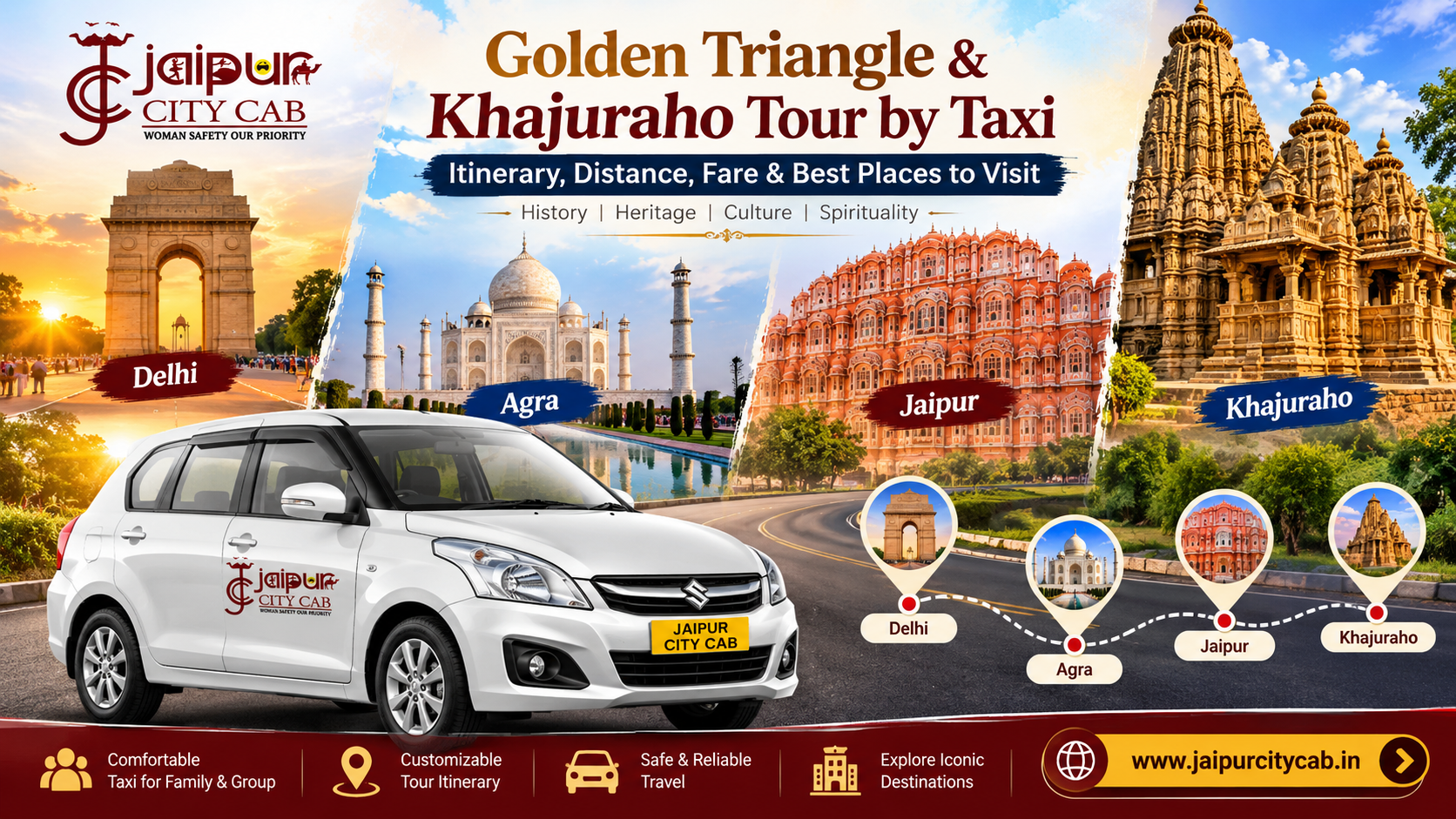

Golden Triangle & Khajuraho Tour by Taxi | Itinerary, Distance, Fare & Best Places to Visit
India is a country where every road seems to lead towards a different chapter of history. Royal capitals, Mughal monuments, colourful markets, ancient temples and living traditions exist within a few hours or a few days of one another. Among the many journeys that introduce travellers to this diversity, the Golden Triangle & Khajuraho Tour by Taxi is especially rewarding because it combines four very different destinations—Delhi, Agra, Jaipur and Khajuraho—within one memorable road journey.
The traditional Golden Triangle connects Delhi, Agra and Jaipur. Delhi represents layers of imperial and modern Indian history, Agra is inseparable from the beauty of the Taj Mahal, and Jaipur introduces travellers to Rajasthan's forts, palaces, bazaars and planned historic city. Adding Khajuraho extends this famous circuit into Madhya Pradesh and introduces an entirely different architectural world through its remarkable group of medieval temples.
For travellers who do not want to rush from one train or flight to another, exploring the Golden Triangle with Khajuraho by private taxi provides valuable flexibility. Your vehicle can pick you up from a hotel, airport or railway station, remain available during sightseeing, stop for meals and photography, and follow a customised itinerary according to your preferred pace.
This detailed travel guide explains the route, approximate road distances, ideal number of days, taxi fare factors, important attractions, Khajuraho temple groups, suggested itineraries, family travel advice and practical planning tips. Whether you are visiting India for the first time or planning a heritage holiday with family, the Delhi–Agra–Jaipur–Khajuraho route offers an excellent introduction to North and Central India's cultural diversity.
Travellers starting or continuing their journey through Rajasthan can use Jaipur taxi services for local and outstation travel. Visitors who want a detailed Pink City experience can also book a Jaipur sightseeing taxi.
Table of Contents
- Golden Triangle & Khajuraho Tour – Overview
- Why Add Khajuraho to the Golden Triangle?
- Route, Distance & Travel Time Guide
- Best Places to Visit in Delhi
- Best Places to Visit in Agra
- Best Places to Visit in Jaipur
- Khajuraho – History, Architecture & Heritage
- Best Places to Visit in Khajuraho
- Western Group of Khajuraho Temples
- Eastern & Southern Temple Groups
- Golden Triangle & Khajuraho Taxi Fare Guide
- Which Taxi Should You Choose?
- 7-Day Tour Itinerary
- 8-Day Recommended Itinerary
- 10-Day Relaxed Itinerary
- Best Time to Plan the Tour
- Family & Senior Citizen Travel
- Photography & Heritage Travel
- Important Road Trip Tips
- Why Choose Jaipur City Cab?
- Frequently Asked Questions
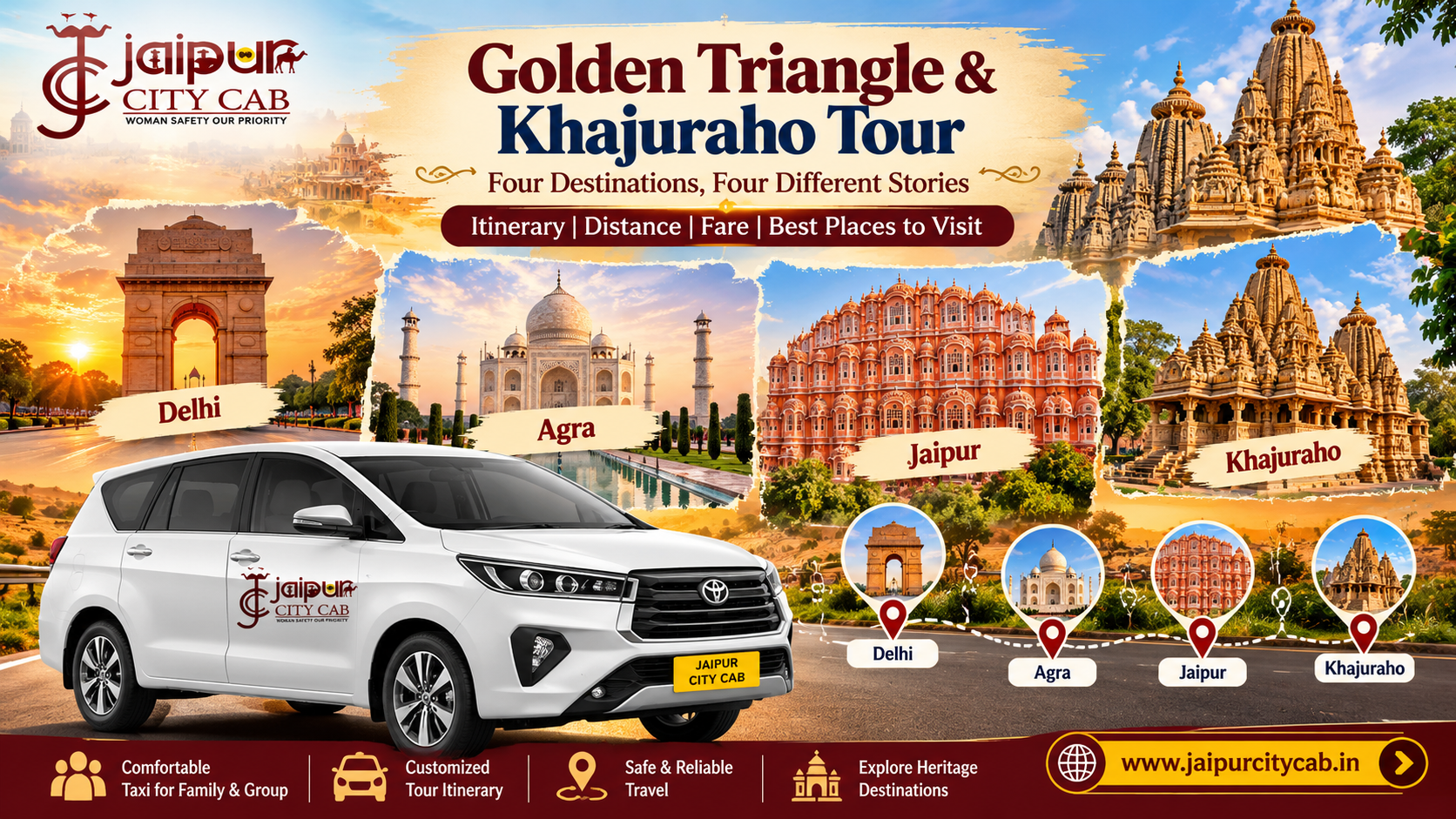
Golden Triangle & Khajuraho Tour – Four Destinations, Four Different Stories
The beauty of this itinerary lies in contrast. Delhi introduces the traveller to an enormous capital where medieval monuments stand beside colonial avenues and modern neighbourhoods. Agra takes the journey into the Mughal period, Jaipur brings Rajasthan's royal heritage and traditional markets into the picture, while Khajuraho carries the traveller much further back into the artistic world of the Chandella rulers.
Rather than viewing these destinations as four unrelated sightseeing stops, it is better to understand the journey as a continuous exploration of Indian architecture and history. In Delhi, travellers see monuments built by different dynasties. Agra reveals the refinement of Mughal architecture. Jaipur demonstrates the vision of a planned royal city, while Khajuraho shows the extraordinary sophistication achieved by medieval temple builders and sculptors.
The tour is therefore suitable for history lovers, photographers, couples, international tourists, families, architecture students and anyone who wants a broader experience than a standard three-city Golden Triangle package.
Why Add Khajuraho to the Classic Golden Triangle Tour?
A normal Golden Triangle itinerary usually ends after Delhi, Agra and Jaipur. This is an excellent first journey through North India, but Khajuraho adds something that none of these three cities can provide.
Khajuraho's temples belong primarily to the Chandella period and are internationally recognised for the relationship between architecture and sculpture. The surviving monuments include Hindu and Jain temples, creating an important record of the religious and artistic environment of medieval central India.
The experience is also visually different. Delhi is a huge metropolis, Agra is a busy historic city and Jaipur is a vibrant state capital. Khajuraho is comparatively quieter, allowing travellers to spend more time observing temple design, stone carvings and the surrounding landscape.
Adding Khajuraho therefore transforms a popular sightseeing circuit into a deeper heritage journey connecting Mughal, Rajput and medieval temple architecture.

Golden Triangle & Khajuraho Route, Distance and Travel Time
The exact total distance depends on your starting point, route and whether additional destinations are included. A practical itinerary generally covers Delhi, Agra, Jaipur and Khajuraho, although the order can be changed according to arrival and departure arrangements.
| Route | Approx. Road Distance | Approx. Driving Time |
|---|---|---|
| Delhi → Agra | Approx. 230–240 km | Approx. 4–5 hours |
| Agra → Jaipur | Approx. 240–250 km | Approx. 5–6 hours |
| Jaipur → Khajuraho | Approx. 600–650 km depending on route | Long full-day road journey; an intermediate stop may be preferable |
| Agra → Khajuraho | Approx. 430–470 km depending on route | Approx. 8–10 hours depending on traffic and stops |
These figures should be treated as planning estimates rather than guaranteed travel times. Highway conditions, city traffic, meal breaks, construction work and sightseeing stops can increase the actual journey duration.
For a comfortable tour, avoid scheduling an important monument immediately after a long road transfer. Keeping one relaxed evening after the longest drive can significantly improve the experience.
Delhi – The Historical Beginning of the Golden Triangle
Delhi is an ideal starting point because it introduces travellers to several centuries of Indian history within one city. Old Delhi offers narrow markets, religious landmarks and Mughal-era heritage, while New Delhi presents wide avenues, government buildings, landscaped areas and later historical monuments.
A well-planned Delhi sightseeing day should avoid trying to cover every attraction. Instead, choose a balanced combination of architecture, local culture and major landmarks.
Best Places to Visit in Delhi
- Red Fort: One of Delhi's most recognisable Mughal monuments.
- Jama Masjid: An important historic mosque in Old Delhi.
- Raj Ghat: Memorial associated with Mahatma Gandhi.
- India Gate: Major landmark of New Delhi.
- Humayun's Tomb: An important example of Mughal garden-tomb architecture.
- Qutub Minar: One of Delhi's best-known historic complexes.
- Lotus Temple: Recognised for its distinctive modern architecture.
- Chandni Chowk: Ideal for experiencing Old Delhi's markets and food culture.
Two nights in Delhi are usually more comfortable than trying to arrive and complete a full sightseeing tour on the same day.
Agra – The Mughal Chapter of Your Journey
The road from Delhi to Agra brings travellers to one of India's most famous heritage destinations. The Taj Mahal naturally dominates the city's tourism identity, but Agra has much more to offer to travellers interested in Mughal history.
Taj Mahal
The Taj Mahal is best experienced without unnecessary hurry. Many travellers prefer morning visits because the atmosphere can be pleasant and the changing light provides excellent photography opportunities.
Agra Fort
Agra Fort adds historical depth to the Taj Mahal visit. Its courtyards, gateways, palaces and defensive architecture help visitors understand Agra as an imperial capital rather than only the location of one famous monument.
Mehtab Bagh
Located across the Yamuna River, Mehtab Bagh is popular with travellers seeking a different perspective of the Taj Mahal, particularly around the evening.
Optional Fatehpur Sikri Stop
When travelling between Agra and Jaipur, Fatehpur Sikri can be included as an important heritage stop. Allow sufficient time rather than treating it as a five-minute photo halt.
Jaipur – Forts, Palaces, Markets and Rajasthan's Royal Character
Jaipur provides the Rajasthan experience within the Golden Triangle. Founded in 1727 under Sawai Jai Singh II, the historic walled city is known for its planned urban form, bazaars, public squares and architectural character.
A private Jaipur sightseeing cab is particularly useful because the major attractions are spread between the old city and the Amber hills.
Amber Fort
Amber Fort is one of the essential Jaipur experiences. Its hill setting, courtyards, gateways and palace areas make it worth allowing enough time rather than rushing through the complex.
Jal Mahal
Jal Mahal provides a convenient photography stop while travelling between Amber and central Jaipur. The palace appears to rise from Man Sagar Lake and is one of the city's most recognisable views.
Hawa Mahal
The famous facade of Hawa Mahal has become a visual symbol of Jaipur. Its location also makes it convenient to combine with the old city's markets and nearby heritage attractions.
City Palace & Jantar Mantar
City Palace introduces visitors to Jaipur's royal heritage, while Jantar Mantar reflects Sawai Jai Singh II's interest in astronomical observation.
Other Jaipur Attractions
- Jaigarh Fort
- Nahargarh Fort
- Albert Hall Museum
- Birla Mandir
- Patrika Gate
- Johari Bazaar
- Bapu Bazaar
Khajuraho – Where Architecture, Sculpture and History Meet
Khajuraho changes the character of the entire journey. The monuments were created under the Chandella dynasty, which flourished in central India during the 10th and 11th centuries. The surviving temples represent both Hindu and Jain religious traditions.
What makes Khajuraho extraordinary is not simply the quantity of sculpture but the way sculptural decoration forms part of the architectural composition. Figures representing deities, musicians, dancers, everyday life, symbolic themes and human relationships appear across the temple surfaces.
The monuments are commonly explored through the Western, Eastern and Southern groups. Travellers should avoid reducing Khajuraho only to its famous erotic imagery. Those carvings represent only one aspect of a much broader artistic programme. The temples reward slow observation of their structure, religious symbolism, decorative detail and craftsmanship.
Best Places to Visit in Khajuraho
| Attraction | Area | Why Visit? |
|---|---|---|
| Kandariya Mahadeva Temple | Western Group | Outstanding temple architecture and sculptural detail |
| Lakshmana Temple | Western Group | Important and richly decorated historic temple |
| Vishvanatha Temple | Western Group | Fine example of Chandella temple design |
| Devi Jagadambi Temple | Western Group | Architecture and detailed sculpture |
| Parsvanatha Temple | Eastern Group | Important Jain heritage |
| Adinath Temple | Eastern Group | Jain religious and architectural significance |
| Vamana Temple | Eastern Group | Historic Hindu temple architecture |
| Duladeo Temple | Southern Group | Later-period temple sculpture |
| Chaturbhuj Temple | Southern Group | Distinctive southern cluster experience |
Western Group of Khajuraho Temples – The Essential Heritage Experience
For first-time visitors, the Western Group should receive the largest share of sightseeing time. Several of Khajuraho's most celebrated monuments are concentrated here, allowing travellers to explore a remarkable sequence of temples without spending much of the day in the vehicle.
Kandariya Mahadeva Temple is particularly significant for the complexity of its architecture and abundance of sculptural decoration. The rising arrangement of its architectural elements creates a powerful sense of vertical movement.
Lakshmana Temple is another major monument and deserves close observation. Vishvanatha and Devi Jagadambi further demonstrate the artistic variety found within the complex.
A knowledgeable local guide can be useful here because many details are easy to overlook when visitors focus only on taking photographs.
Eastern & Southern Groups – Discover the Quieter Side of Khajuraho
After the Western Group, travellers with adequate time should explore the Eastern and Southern clusters. The Eastern Group is especially important because it includes Jain monuments such as Parsvanatha and Adinath as well as Hindu temples.
The Southern Group includes Duladeo and Chaturbhuj temples. These areas are generally less overwhelming than the principal Western complex and can provide a more relaxed experience.
Together, all three groups help visitors understand Khajuraho as a historic religious landscape rather than a single temple attraction.
Golden Triangle & Khajuraho Tour Taxi Fare – How Is the Price Calculated?
A fixed taxi price should not be assumed without first finalising the itinerary. The total fare for a Delhi, Agra, Jaipur and Khajuraho tour depends on the number of days, vehicle type, total kilometres, pickup point, final drop location and additional sightseeing.
| Fare Component | What Affects the Cost? |
|---|---|
| Vehicle Type | Sedan, SUV, Innova, Innova Crysta or Tempo Traveller |
| Total Distance | Complete tour kilometres according to final route |
| Tour Duration | Number of travel and sightseeing days |
| Driver Allowance | May apply for multi-day outstation tours |
| Toll & Parking | Depends on highways and sightseeing locations |
| State / Local Charges | Where applicable according to route and vehicle |
| Night Driving | Additional charges may apply according to booking conditions |
| Extra Kilometres | Additional detours or destinations beyond confirmed itinerary |
Before booking, request a clear quotation mentioning what is included and what will be charged separately. This prevents confusion during a long multi-state road journey.
Which Vehicle Is Best for the Golden Triangle & Khajuraho Tour?
Because this itinerary includes long-distance road travel, comfort should receive more importance than simply choosing the cheapest vehicle.
| Vehicle | Recommended For | Travel Style |
|---|---|---|
| Sedan | 1–3 travellers with moderate luggage | Economical private tour |
| Ertiga / Similar MPV | Small family | Extra passenger and luggage flexibility |
| Innova | Family / 4–6 travellers depending on luggage | Comfortable long-distance road trip |
| Innova Crysta | Travellers preferring additional comfort | Premium multi-day touring |
| Tempo Traveller | Larger family or group | Group road trip |
Large groups can explore bus rental in Jaipur or request a suitable group vehicle according to passenger and luggage requirements.
7-Day Golden Triangle & Khajuraho Tour Itinerary
Day 1 – Arrival in Delhi
Meet your driver at Delhi Airport, railway station or hotel. Depending on arrival time, begin with India Gate, Raj Ghat or another nearby attraction. Overnight stay in Delhi.
Day 2 – Delhi Sightseeing
Explore major attractions such as Qutub Minar, Humayun's Tomb, India Gate, Old Delhi and selected historic landmarks. Avoid overcrowding the day with too many stops.
Day 3 – Delhi → Agra
Drive to Agra. Visit Agra Fort and Mehtab Bagh. Keep the Taj Mahal for the next morning if you prefer a quieter sunrise or early-morning experience.
Day 4 – Agra → Jaipur
Visit the Taj Mahal according to current opening conditions. After breakfast, depart for Jaipur. Fatehpur Sikri can be included en route if time permits. Arrive in Jaipur and relax.
Day 5 – Jaipur Sightseeing
Explore Amber Fort, Jal Mahal, Hawa Mahal, City Palace, Jantar Mantar and local markets. Stay overnight in Jaipur.
Day 6 – Jaipur → Khajuraho / Planned Long Transfer
This is a substantial road journey. Depending on the selected route and traveller comfort, it may be preferable to use an intermediate overnight halt rather than forcing a tiring drive.
Day 7 – Khajuraho Sightseeing
Explore the Western Group and, depending on available time, selected Eastern or Southern temples. Continue to your onward destination or arrange an additional night in Khajuraho.
Note: Seven days is possible only with careful routing. For most families, an eight- or ten-day itinerary is more comfortable.
8-Day Golden Triangle & Khajuraho Tour – Recommended Itinerary
| Day | Destination | Suggested Plan |
|---|---|---|
| Day 1 | Delhi | Arrival, hotel transfer and relaxed local sightseeing |
| Day 2 | Delhi | Old Delhi + New Delhi sightseeing |
| Day 3 | Delhi → Agra | Drive to Agra, Agra Fort and Mehtab Bagh |
| Day 4 | Agra → Jaipur | Taj Mahal, optional Fatehpur Sikri, Jaipur arrival |
| Day 5 | Jaipur | Full-day Jaipur sightseeing |
| Day 6 | Jaipur → Intermediate Stop / Khajuraho Route | Comfortable road transfer with planned breaks |
| Day 7 | Khajuraho | Western Group + Eastern Group |
| Day 8 | Khajuraho | Southern Group / local sightseeing / onward departure |
10-Day Golden Triangle & Khajuraho Tour – Relaxed Heritage Journey
Travellers with ten days can enjoy the route much more comfortably and include additional heritage experiences without converting every day into a race against the clock.
Day 1 – Delhi Arrival
Airport pickup, hotel check-in and relaxed evening.
Day 2 – Old Delhi
Red Fort area, Jama Masjid, Chandni Chowk and Raj Ghat according to interest and current access.
Day 3 – New Delhi
Qutub Minar, Humayun's Tomb, India Gate and selected modern landmarks.
Day 4 – Delhi to Agra
Drive to Agra and explore Agra Fort and Mehtab Bagh.
Day 5 – Agra to Jaipur
Visit the Taj Mahal, then travel towards Jaipur with optional Fatehpur Sikri stop.
Day 6 – Jaipur Sightseeing
Amber Fort, Jal Mahal, Hawa Mahal, City Palace, Jantar Mantar and bazaars.
Day 7 – Jaipur Additional Sightseeing / Relaxed Morning
Explore Jaigarh, Nahargarh, Albert Hall, Patrika Gate or enjoy shopping before the next long road section.
Day 8 – Jaipur to Khajuraho Route
Begin the long transfer with an appropriate intermediate halt if required.
Day 9 – Khajuraho Western & Eastern Groups
Spend the day exploring the principal temple complexes without rushing.
Day 10 – Southern Group & Departure
Visit remaining attractions according to departure time and continue to the airport, railway station or next destination.
Best Time for a Golden Triangle & Khajuraho Road Tour
For most travellers, the cooler months from approximately October to March are convenient for a long heritage road trip. Walking through forts, palace courtyards and open temple complexes is generally easier in moderate weather.
December and January can bring colder mornings to Delhi and northern India, so light winter clothing may be necessary. April to June can become extremely hot, particularly during afternoon sightseeing.
The monsoon season creates greener landscapes but occasional heavy rain can affect driving conditions and outdoor sightseeing. Regardless of season, keep some flexibility in the itinerary.
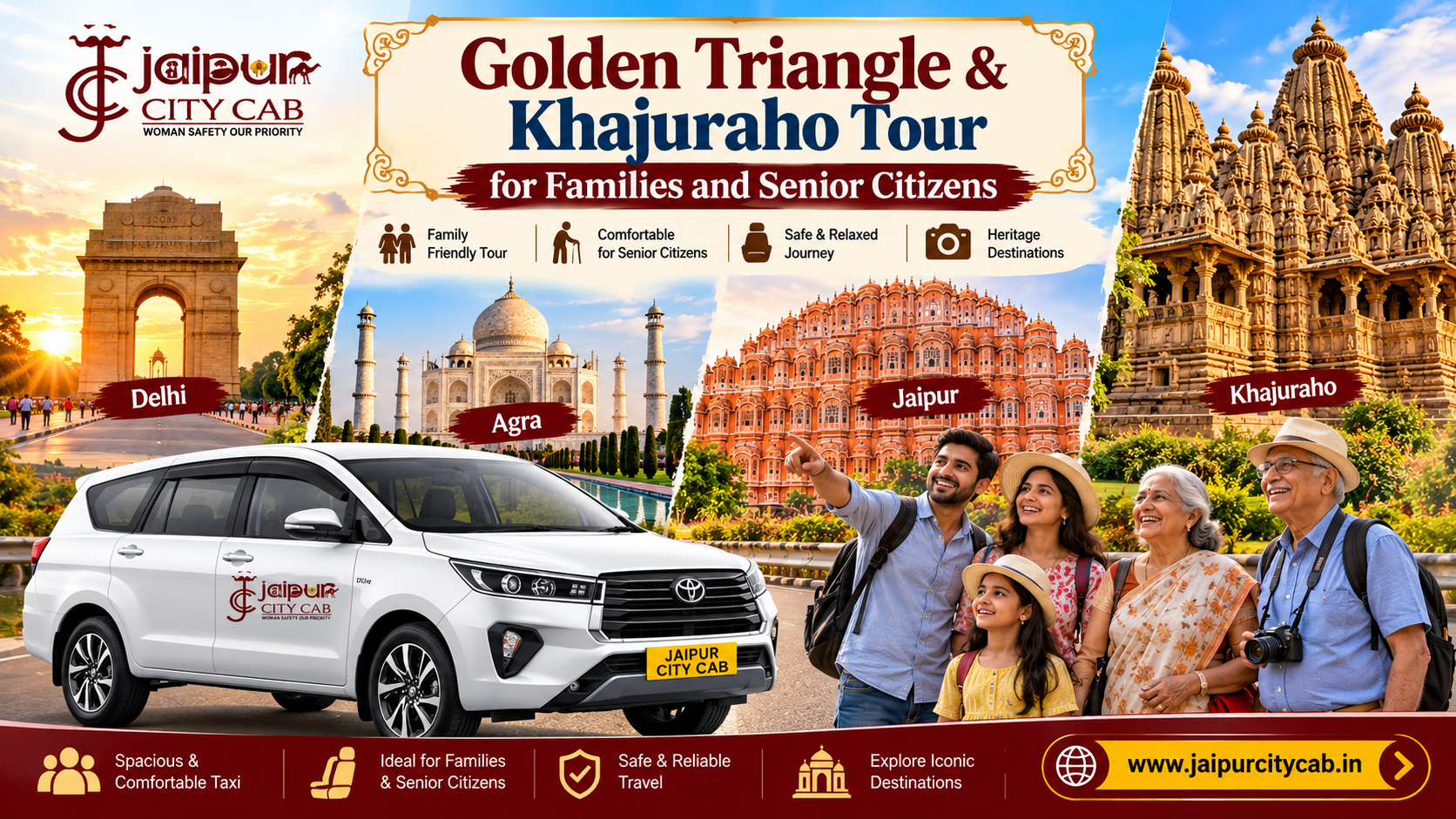
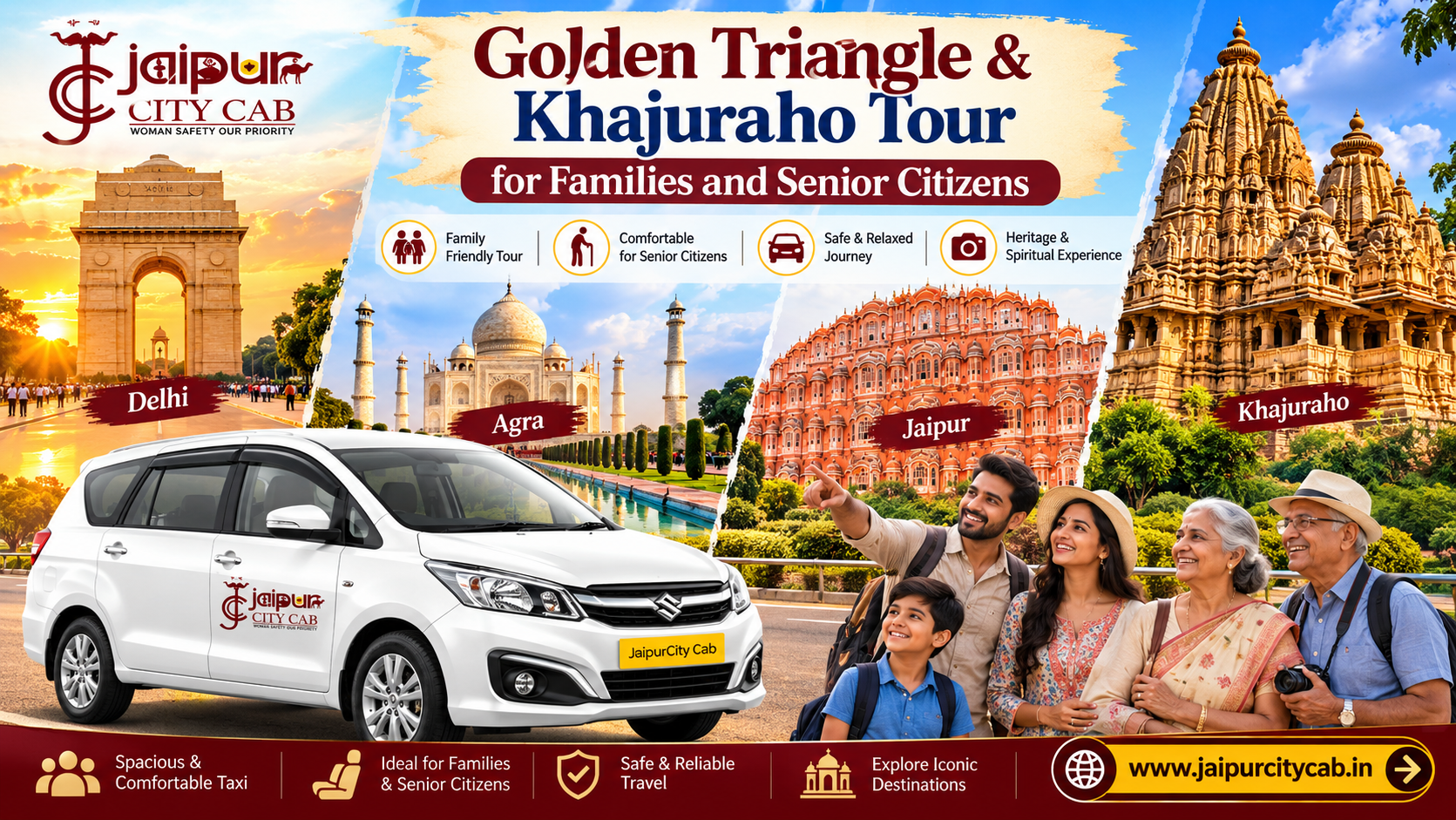
Golden Triangle & Khajuraho Tour for Families and Senior Citizens
This tour can work very well for families, but the itinerary should be planned according to the oldest and youngest travellers rather than the fastest member of the group.
Senior citizens may find repeated long-distance transfers tiring. An Innova, Innova Crysta or another spacious vehicle can provide greater comfort on long road sections. Frequent rest stops and sensible hotel locations are also important.
- Avoid unnecessary overnight road travel.
- Keep medicines and drinking water accessible.
- Choose hotels close to main sightseeing areas.
- Do not overload each day with monuments.
- Allow lunch and rest breaks.
- Confirm accessibility if any traveller has mobility limitations.
A Dream Route for Heritage & Travel Photography
Few Indian road itineraries provide as much visual variety as Delhi, Agra, Jaipur and Khajuraho. Delhi offers monumental architecture and street scenes; Agra provides symmetrical Mughal compositions; Jaipur brings colourful facades, hill forts and markets; and Khajuraho offers intricate stone sculpture.
Photography rules differ between monuments and may change, especially for tripods, professional equipment, restricted interiors and drone use. Always follow the current rules displayed at each site.
Morning and late-afternoon light can be particularly attractive for exterior architecture. At Khajuraho, details often become more visible when sunlight falls across the carved surfaces at an angle.
Important Travel Tips for Delhi, Agra, Jaipur & Khajuraho
- Keep at least 8–10 days if you prefer relaxed travel.
- Confirm monument closing days before finalising the itinerary.
- Begin highway drives early whenever practical.
- Keep passport or valid ID as required.
- Carry comfortable walking shoes.
- Keep water, sunscreen and seasonal clothing.
- Do not leave valuables visible inside the vehicle.
- Confirm hotel parking when travelling with a larger vehicle.
- Ask whether toll, parking and driver allowance are included in the quotation.
- Keep enough time between sightseeing and train or flight departures.
- Use authorised guides when detailed monument interpretation is required.
- Plan Khajuraho as a heritage destination, not merely a short photo stop.
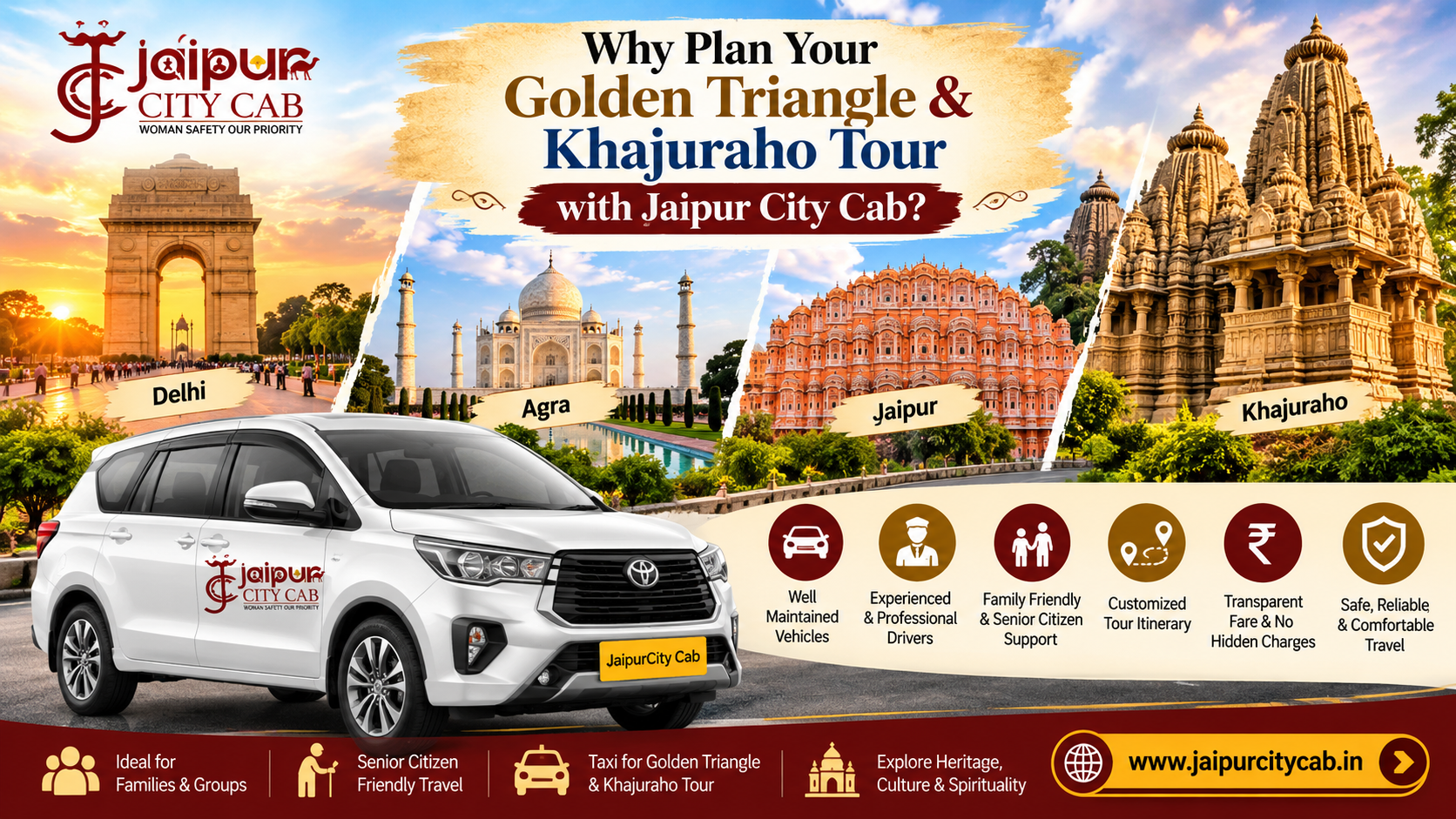
Why Plan Your Golden Triangle & Khajuraho Tour with Jaipur City Cab?
A multi-city journey requires more planning than a local sightseeing tour. The route must account for total kilometres, hotel locations, sightseeing hours, highway travel, luggage, passenger comfort and the final departure point.
With a private taxi, the itinerary can be customised according to your preferred number of days. Couples can select a sedan, families can choose an SUV or Innova, and larger groups can request a Tempo Traveller or suitable group vehicle.
For local and outstation travel, explore taxi service in Jaipur.
For Pink City forts, palaces and markets, choose Jaipur local sightseeing taxi service.
If your tour begins or ends with a flight in Jaipur, check Jaipur Airport taxi service.
Larger families and tour groups can explore bus rental in Jaipur.
For customised Golden Triangle, Rajasthan and multi-city taxi journeys, visit Jaipur City Cab.
Frequently Asked Questions About Golden Triangle & Khajuraho Tour by Taxi
Q1. What is the Golden Triangle & Khajuraho Tour?
Answer: It is an extended Golden Triangle itinerary covering Delhi, Agra and Jaipur along with Khajuraho in Madhya Pradesh, combining Mughal, Rajput and medieval temple heritage.
Q2. How many days are required for Delhi, Agra, Jaipur and Khajuraho?
Answer: Around 8 to 10 days is comfortable for most travellers. A shorter 7-day tour is possible but requires faster travel and careful route planning.
Q3. Can I do the Golden Triangle & Khajuraho Tour by private taxi?
Answer: Yes. A private taxi is useful for travellers who want flexible sightseeing, hotel pickup, luggage convenience and customised stops.
Q4. Which cities are included in the Golden Triangle?
Answer: The traditional Golden Triangle includes Delhi, Agra and Jaipur. Khajuraho can be added as an extended heritage destination.
Q5. What is Khajuraho famous for?
Answer: Khajuraho is famous for its historic Hindu and Jain temple complexes, Nagara-style architecture and exceptionally detailed stone sculpture associated with the Chandella period.
Q6. What are the main temples to see in Khajuraho?
Answer: Important monuments include Kandariya Mahadeva, Lakshmana, Vishvanatha, Devi Jagadambi, Parsvanatha, Adinath, Vamana, Duladeo and Chaturbhuj temples.
Q7. How is the taxi fare for the tour calculated?
Answer: The fare depends on vehicle type, total kilometres, number of days, pickup and drop points, tolls, parking, driver allowance and any additional sightseeing.
Q8. Which vehicle is best for this tour?
Answer: A sedan can suit a couple or small group, while an Innova or Innova Crysta is comfortable for families. Larger groups can choose a Tempo Traveller or bus.
Q9. What is the best time for a Golden Triangle and Khajuraho tour?
Answer: October to March is generally comfortable for long road journeys and outdoor heritage sightseeing, although the tour can be customised for other seasons.
Q10. Can Fatehpur Sikri be included in this tour?
Answer: Yes. Fatehpur Sikri can conveniently be considered on the Agra–Jaipur portion of the itinerary when enough sightseeing time is available.
Q11. Is this tour suitable for senior citizens?
Answer: Yes, but a relaxed itinerary with comfortable vehicles, adequate rest stops and fewer long sightseeing days is recommended.
Q12. Can the itinerary start from Jaipur instead of Delhi?
Answer: Yes. The route can be customised according to your airport, railway station, hotel and onward travel plans.
Conclusion – Experience Four Remarkable Heritage Destinations in One Journey
The Golden Triangle & Khajuraho Tour by Taxi is much more than an extended sightseeing package. It is a journey through different periods of Indian history and different forms of architecture.
Delhi introduces centuries of political and cultural change. Agra reveals the refinement of Mughal architecture through the Taj Mahal and Agra Fort. Jaipur adds Rajasthan's forts, royal palaces, traditional markets and historic city planning. Khajuraho completes the journey with a remarkable group of medieval temples where architecture and sculpture exist in extraordinary harmony.
The real advantage of a private road journey is freedom. Travellers are not restricted to a rigid group-tour schedule. A family can spend longer at Amber Fort, stop for photographs between Agra and Jaipur, take an additional rest break during a long transfer or dedicate a full day to the temples of Khajuraho.
For travellers with limited time, a seven-day itinerary can cover the principal highlights, but an eight- to ten-day tour provides a more enjoyable balance between sightseeing and travel. The itinerary can also be customised with additional stops according to interests and onward travel plans.
Before booking, finalise the number of passengers, preferred vehicle, hotels, sightseeing priorities and final drop location. Request a clear fare quotation covering kilometres, driver allowance, tolls, parking and other applicable charges.
To plan a customised Delhi Agra Jaipur Khajuraho Tour by Taxi, Golden Triangle road trip, Rajasthan tour or private multi-city journey, visit Jaipur City Cab and prepare an itinerary according to your travel dates, passenger count and preferred destinations.


