



15 Must-Visit Temples in Rajasthan: Timings, Aarti, Travel & Complete Travel Guide
Rajasthan is famous across the world for forts, palaces, desert landscapes and royal heritage, but the state is equally important for spiritual travel. From ancient Krishna temples and hilltop Shiva shrines to famous Hanuman temples, Jain pilgrimage sites and desert temples close to the international border, Rajasthan offers a remarkably diverse religious circuit.
A well-planned Rajasthan temple tour can take travelers from Jaipur to Khatu Shyam Ji and Salasar Balaji, onward to Pushkar, Nathdwara, Udaipur, Ranakpur, Mount Abu, Bikaner and Jaisalmer. Because these pilgrimage destinations are spread across different regions, route planning is extremely important.
Travelers should also understand that temple schedules in Rajasthan are not always fixed throughout the year. Darshan and aarti timings may change according to summer and winter seasons, festivals, Ekadashi, Janmashtami, Navratri, special bhog, temple traditions and crowd-control arrangements.
This complete guide covers 15 must-visit temples in Rajasthan with practical information about location, typical darshan timings, important aartis, ideal visiting periods, nearby attractions, road connections and suggested temple-tour itineraries.
If you are starting your pilgrimage from Jaipur, you can arrange a comfortable taxi service in Jaipur for local temples as well as Rajasthan outstation routes.
Table of Contents
- Rajasthan Temple Tour – Quick Overview
- 1. Govind Dev Ji Temple, Jaipur
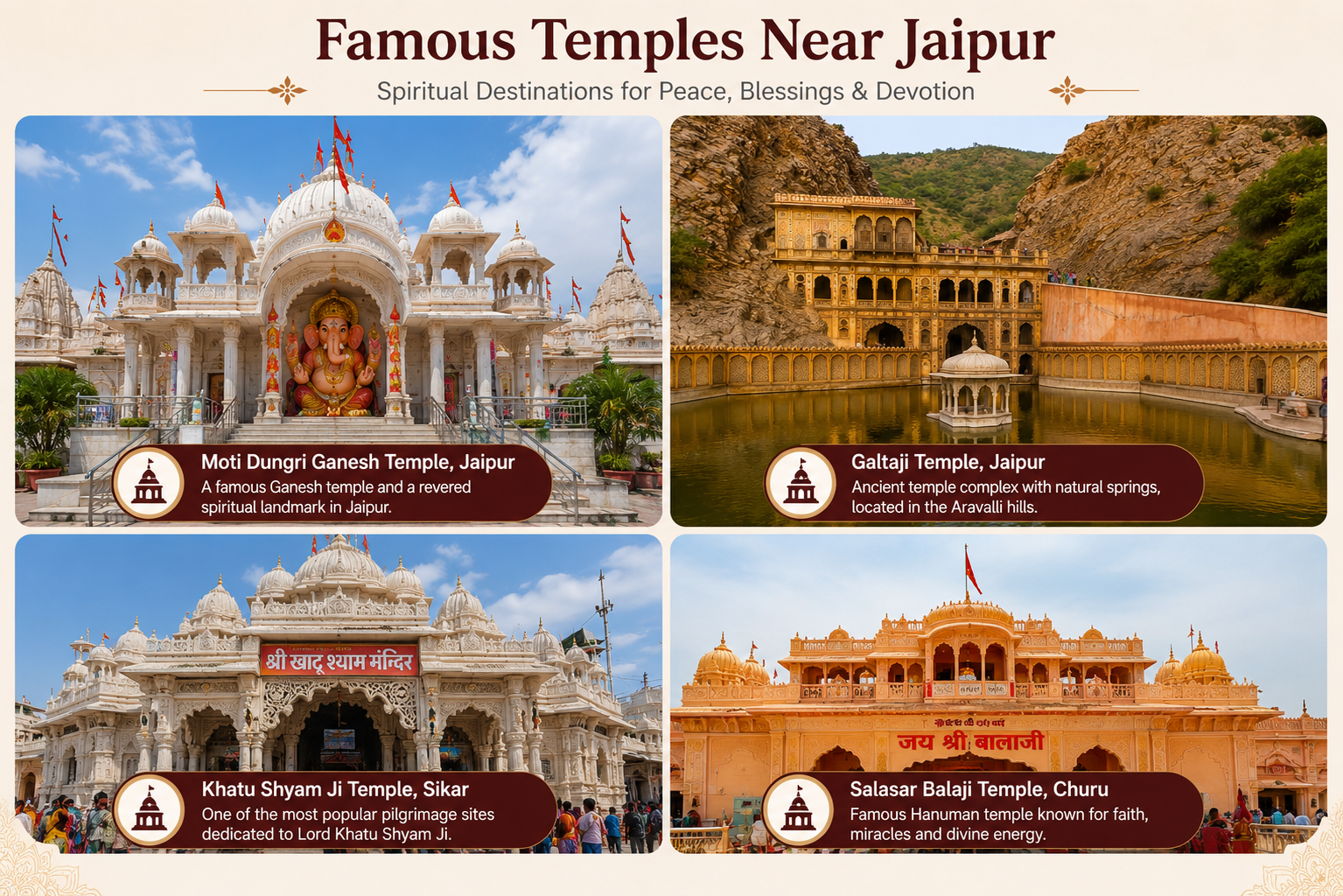
- 2. Moti Dungri Ganesh Temple, Jaipur
- 3. Galtaji Temple, Jaipur
- 4. Khatu Shyam Ji Temple, Sikar
- 5. Salasar Balaji Temple, Churu
- 6. Mehandipur Balaji Temple, Dausa
- 7. Brahma Temple, Pushkar
- 8. Shrinathji Temple, Nathdwara
- 9. Eklingji Temple, Udaipur
- 10. Jagdish Temple, Udaipur
- 11. Ranakpur Jain Temple
- 12. Dilwara Jain Temples, Mount Abu
- 13. Karni Mata Temple, Deshnok
- 14. Ramdevra Temple
- 15. Tanot Mata Temple, Jaisalmer
- Temple Timings at a Glance
- Suggested Rajasthan Temple Tour Itinerary
- Jaipur Religious Circuit
- Udaipur & Nathdwara Temple Circuit
- Bikaner & Jaisalmer Temple Circuit
- Best Vehicle for Rajasthan Temple Tour
- Temple Travel Tips
- Frequently Asked Questions
Rajasthan Temple Tour – Quick Overview
Rajasthan's temple circuit can roughly be divided into four major zones. Jaipur and the surrounding region cover Govind Dev Ji, Moti Dungri, Galtaji, Khatu Shyam Ji, Salasar Balaji and Mehandipur Balaji. Central Rajasthan includes Pushkar's Brahma Temple. Southern Rajasthan covers Nathdwara, Eklingji, Jagdish Temple, Ranakpur and Mount Abu. Western Rajasthan includes Karni Mata, Ramdevra and Tanot Mata.
| Region | Main Temples | Recommended Stay |
|---|---|---|
| Jaipur & Nearby | Govind Dev Ji, Moti Dungri, Galtaji, Khatu Shyam, Salasar, Mehandipur | Jaipur |
| Pushkar Region | Brahma Temple | Pushkar / Ajmer |
| Udaipur Region | Shrinathji, Eklingji, Jagdish Temple | Udaipur / Nathdwara |
| Ranakpur & Mount Abu | Ranakpur Jain Temple, Dilwara Jain Temples | Ranakpur / Mount Abu |
| Bikaner Region | Karni Mata Temple | Bikaner |
| Jaisalmer Region | Ramdevra, Tanot Mata | Jaisalmer |

1. Govind Dev Ji Temple, Jaipur
Located inside the City Palace complex area, Govind Dev Ji Temple is one of Jaipur's most important Krishna temples. The deity is deeply connected with Jaipur's royal history, and thousands of devotees attend the different jhanki darshans throughout the day.
The temple follows multiple daily darshan periods rather than remaining continuously open for unrestricted darshan. Typical temple operating periods are approximately 5:30 AM to 1:30 PM and 4:30 PM to 9:00 PM, although individual jhanki timings vary.
Important rituals commonly include Mangala, Dhoop, Shringar, Rajbhog, Gwal, Sandhya and Shayan darshan. Janmashtami is one of the most important festivals here and attracts extremely large crowds.
Best time to visit: Early morning for Mangala darshan or an evening jhanki.
Nearby attractions: City Palace, Jantar Mantar, Hawa Mahal and Tripolia Bazaar.
Visitors can easily include Govind Dev Ji while booking a Jaipur sightseeing taxi.
2. Moti Dungri Ganesh Temple, Jaipur
Moti Dungri Ganesh Temple is one of Jaipur's most frequently visited temples and is especially important for devotees beginning a new journey, marriage, business or auspicious event.
The temple is known for several daily darshan periods and traditional bhajans. Wednesday is considered particularly important, and the area can become significantly busier in the evening.
Typical temple hours are around 5:30 AM to 1:30 PM and later in the afternoon and evening until approximately 9:00 PM. Seasonal aarti timings may change.
Major festival: Ganesh Chaturthi.
Nearby places: Birla Mandir, Albert Hall Museum and Central Park.
3. Galtaji Temple, Jaipur
Situated in the Aravalli hills east of Jaipur, Galtaji is a historic pilgrimage complex famous for temples, natural water kunds and its dramatic valley setting.
The complex is generally accessible from around 5:00 AM to 9:00 PM. Sunrise and early morning are particularly atmospheric because the weather is cooler and the surrounding hills are quieter.
Many visitors combine Galtaji with the nearby Sun Temple and then continue towards Jaipur's old city.
Best time: October to March, especially early morning.
Travel tip: Wear footwear suitable for walking and keep belongings secure around monkeys.
4. Khatu Shyam Ji Temple, Sikar
Khatu Shyam Ji is among Rajasthan's most visited pilgrimage destinations and attracts devotees from Jaipur, Delhi, Haryana and many other parts of India.
The temple follows separate summer and winter schedules. Typical winter darshan hours are approximately 5:30 AM to 1:00 PM and 5:00 PM to 9:00 PM. In summer, the temple generally opens earlier, around 4:30 AM, with evening darshan extending towards 10:00 PM.
The five important daily aartis are:
- Mangala Aarti
- Shringar Aarti
- Bhog Aarti
- Sandhya Aarti
- Shayan Aarti
The annual Phalgun Mela is the busiest period. During special festival arrangements, ordinary timings and entry routes may be changed.
Approximate distance from Jaipur: Around 80 km.
A Jaipur–Khatu trip can be comfortably arranged through an outstation taxi from Jaipur.
5. Salasar Balaji Temple, Churu
Salasar Balaji is one of Rajasthan's most famous Hanuman temples and is frequently combined with Khatu Shyam Ji in a same-day or overnight pilgrimage circuit.
Current published schedules generally place darshan between approximately 6:00 AM and 9:00 PM. Seasonal aarti schedules differ between winter and summer.
Typical important rituals include Mangala Aarti, Rajbhog Aarti, Sandhya Aarti and Shayan Aarti. Tuesdays and Saturdays usually attract more devotees.
Recommended route from Jaipur: Jaipur → Khatu Shyam Ji → Salasar Balaji → Jaipur.
For senior citizens, staying overnight near Salasar or Khatu can make this circuit more comfortable.
6. Mehandipur Balaji Temple, Dausa
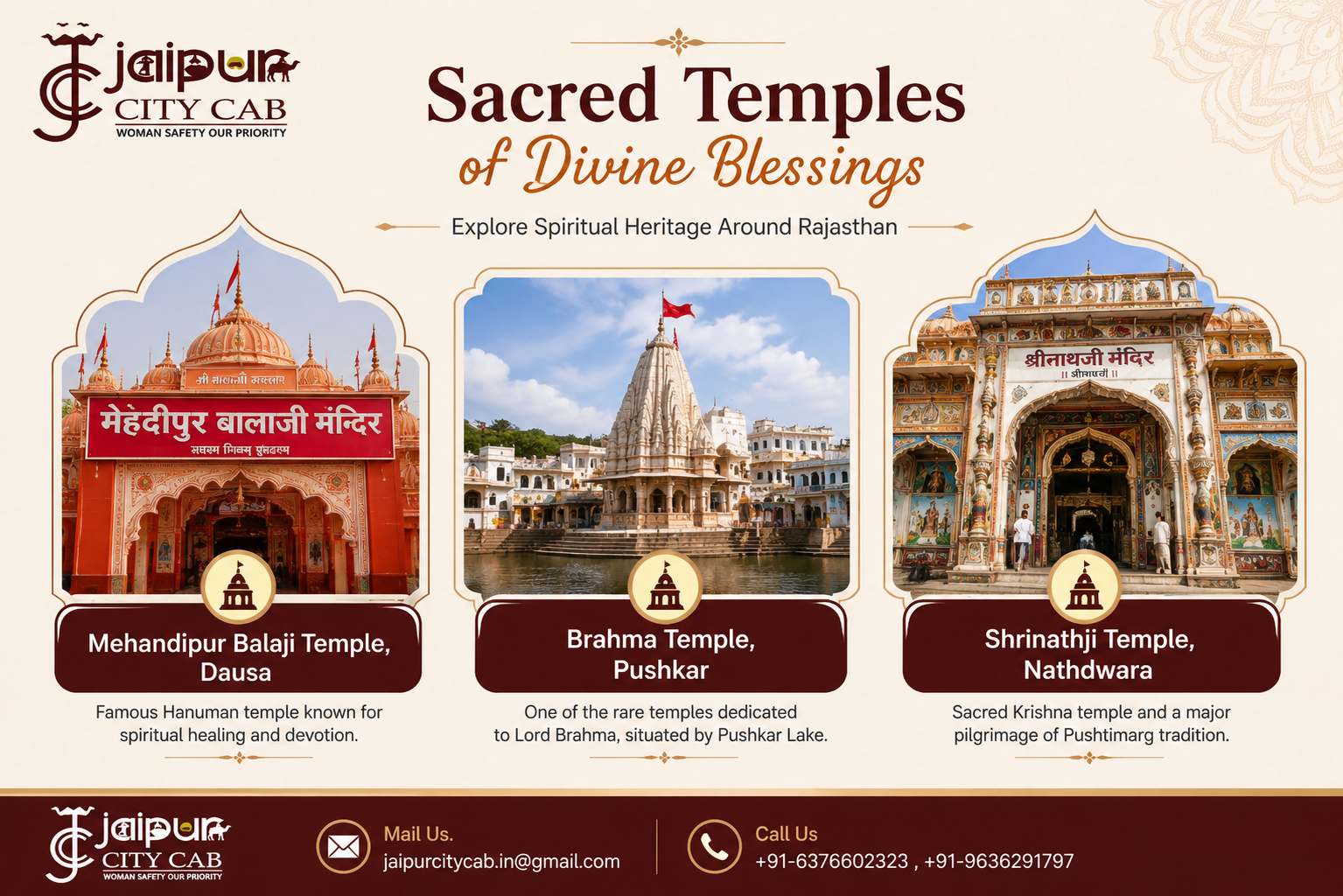
Mehandipur Balaji is located in Dausa district on the Jaipur–Agra side and is dedicated to Lord Hanuman. It attracts devotees throughout the year.
The temple is generally open from approximately 6:00 AM to 9:00 PM. Morning darshan is commonly available from around 7:00 AM to 11:00 AM, followed by afternoon and evening darshan periods.
The published morning aarti period is approximately 6:00 AM to 6:40 AM, while evening aarti is generally around 6:50 PM to 7:30 PM. Darshan arrangements may pause during aarti.
Photography and video recording inside the temple are generally restricted, so visitors should follow temple rules carefully.
Approximate distance from Jaipur: Around 100 km.
This temple can also be included in a Jaipur–Agra road itinerary if your travel schedule allows.
7. Brahma Temple, Pushkar
The Jagatpita Brahma Temple is the most famous temple in Pushkar and one of the best-known temples dedicated to Lord Brahma.
Typical visiting hours are approximately 5:00 AM to 1:30 PM and 3:00 PM to 9:00 PM. Morning Mangala Aarti is an excellent option for devotees who stay overnight in Pushkar.
After temple darshan, visitors can walk towards Pushkar Lake and its ghats. Kartik Purnima and the Pushkar Fair period bring particularly large numbers of visitors.
Recommended trip: Jaipur → Ajmer → Pushkar Brahma Temple → Pushkar Lake → Jaipur.
8. Shrinathji Temple, Nathdwara
Shrinathji Temple in Nathdwara is one of India's most important Krishna pilgrimage centres and follows the Pushtimarg tradition.
Instead of remaining continuously open, the temple offers multiple short darshan periods during the day. The principal darshans traditionally include:
- Mangla
- Shringar
- Gwal
- Rajbhog
- Utthapan
- Bhog
- Aarti
- Shayan
Mangla is normally early morning, around the 5:30–6:30 AM period, while Rajbhog is generally around late morning. Evening Bhog-Aarti commonly takes place around the 5:00–6:00 PM period, but the exact schedule changes according to daily seva.
Because timing variations are common at Nathdwara, travelers should check the temple's same-day darshan schedule before departure.
9. Eklingji Temple, Udaipur
Eklingji Temple is an important Shiva temple located north of Udaipur and has a strong historical connection with the rulers of Mewar.
Darshan generally operates in separate sessions: approximately 4:30 AM to 7:00 AM, 10:30 AM to 1:30 PM and 5:00 PM to 7:30 PM.
Monday is particularly important for Shiva devotees, while Mahashivratri attracts heavy crowds.
Travel planning: Eklingji can easily be combined with Nathdwara because both are located north of Udaipur.
Recommended route: Udaipur → Eklingji → Nathdwara → Udaipur.
10. Jagdish Temple, Udaipur
Jagdish Temple is located near Udaipur City Palace and is one of the city's most recognizable religious landmarks.
The temple is generally open approximately 4:30 AM to 1:00 PM and again from around 5:00 PM to 8:00 PM.
Because of its central location, Jagdish Temple can easily be combined with City Palace, Lake Pichola and the old city markets.
Best time: Early morning before Udaipur sightseeing or evening before dinner around the old city.
11. Ranakpur Jain Temple
Ranakpur Jain Temple is one of Rajasthan's architectural masterpieces. The complex is located among the Aravalli hills and is primarily dedicated to Adinath, the first Jain Tirthankara.
The temple is famous for its marble architecture and 1,444 intricately carved pillars. Visitor access timings can differ between worship periods for Jain devotees and tourist visiting hours.
Evening aarti takes place after sunset in the main shrine. Non-Jain tourists should follow current entry rules regarding clothing, photography and permitted visiting periods.
Ideal route: Udaipur → Ranakpur → Kumbhalgarh or Jodhpur.
A private cab is particularly useful on this route because Ranakpur is surrounded by hilly roads and is usually included within a multi-destination itinerary.
12. Dilwara Jain Temples, Mount Abu
Dilwara is a celebrated group of Jain temples in Mount Abu known for extraordinary marble carving and spiritual importance.
The complex is generally open from around 6:00 AM to 6:00 PM. Jain devotees are typically given morning worship access, while tourist visiting hours often begin around noon.
Mobile phones, cameras and leather articles may be restricted inside the complex. Visitors should also wear modest clothing.
Nearby attractions: Nakki Lake, Guru Shikhar, Achalgarh and Sunset Point.
13. Karni Mata Temple, Deshnok
Karni Mata Temple at Deshnok near Bikaner is famous for the thousands of sacred rats, locally known as kabbas, that live inside the temple complex.
Rajasthan Tourism lists the temple as open from early morning until late evening, generally around 4:00 AM to 10:00 PM. Mangla Aarti and bhog offerings are important parts of daily worship.
The temple becomes especially busy during Chaitra and Ashwin Navratri.
Approximate distance from Bikaner: Around 30–35 km.
Suggested route: Bikaner → Karni Mata Deshnok → Bikaner.
14. Ramdevra Temple
Ramdevra is the sacred place associated with Baba Ramdev Ji, also respectfully known as Ramdev Pir. The pilgrimage site attracts devotees from Rajasthan, Gujarat, Madhya Pradesh and several other states.
The annual Ramdevra fair is one of the most important periods for visiting devotees, but it is also the busiest. Visitors planning during the mela should expect road diversions, longer queues and higher accommodation demand.
Temple hours can change seasonally and during fairs, so travelers should verify the current darshan schedule before arriving.
Ramdevra can be conveniently added while driving between Jodhpur and Jaisalmer.
Suggested route: Jodhpur → Pokaran → Ramdevra → Jaisalmer.
15. Tanot Mata Temple, Jaisalmer
Tanot Mata Temple lies in the desert region close to the India–Pakistan border, roughly 120 km from Jaisalmer. The temple has a strong connection with the Indian armed forces and is associated with stories from the 1965 India–Pakistan war.
The temple is currently associated with BSF management and is frequently combined with Longewala in a same-day excursion from Jaisalmer.
Because this route travels towards a sensitive border region, travelers should carry valid identification and follow all BSF and local authority instructions.
Recommended route: Jaisalmer → Tanot Mata → Longewala → Jaisalmer.
Start early because the route is long and services between Jaisalmer and Tanot are limited compared with city areas.
15 Rajasthan Temples – Timings & Aarti Quick Reference
| Temple | Typical Darshan Timing | Important Aarti / Ritual |
|---|---|---|
| Govind Dev Ji, Jaipur | Approx. 5:30 AM–1:30 PM & 4:30 PM–9:00 PM | Mangala, Shringar, Rajbhog, Sandhya, Shayan |
| Moti Dungri Ganesh | Morning & Evening Sessions | Multiple Daily Darshans |
| Galtaji | Approx. 5:00 AM–9:00 PM | Morning & Evening Worship |
| Khatu Shyam Ji | Seasonal Split Timings | 5 Major Daily Aartis |
| Salasar Balaji | Approx. 6:00 AM–9:00 PM | Mangala, Rajbhog, Sandhya, Shayan |
| Mehandipur Balaji | Approx. 6:00 AM–9:00 PM | Morning 6:00 AM; Evening around 6:50 PM |
| Brahma Temple Pushkar | 5:00 AM–1:30 PM & 3:00 PM–9:00 PM | Mangala & Evening Aarti |
| Shrinathji Nathdwara | Multiple Short Darshan Slots | 8 Traditional Darshans |
| Eklingji | 4:30–7:00 AM, 10:30 AM–1:30 PM, 5:00–7:30 PM | Shiva Worship & Special Monday Darshan |
| Jagdish Temple | 4:30 AM–1:00 PM & 5:00–8:00 PM | Morning & Evening Aarti |
| Ranakpur Jain Temple | Worship & Tourist Hours Vary | Evening Aarti |
| Dilwara Jain Temples | Approx. 6:00 AM–6:00 PM | Jain Worship Sessions |
| Karni Mata | Approx. 4:00 AM–10:00 PM | Mangla Aarti & Bhog |
| Ramdevra | Seasonal – Verify Before Visit | Morning & Evening Worship |
| Tanot Mata | Verify Same-Day Schedule | Daily Mata Aarti |
Suggested 8-Day Rajasthan Temple Tour Itinerary
Because these temples are spread across a large geographical area, trying to cover all of them in only three or four days is not practical. The following itinerary creates a more logical road circuit.
Day 1 – Jaipur Temple Tour
Govind Dev Ji → Moti Dungri Ganesh Temple → Galtaji → Jaipur Hotel
Begin with an early morning darshan at Govind Dev Ji before continuing towards Moti Dungri. After lunch or later in the afternoon, visit Galtaji.
Day 2 – Khatu Shyam Ji & Salasar
Jaipur → Khatu Shyam Ji → Salasar Balaji → Jaipur
Start before sunrise to reach Khatu before the major daytime crowd. Continue to Salasar after darshan and return to Jaipur in the evening.
Day 3 – Mehandipur & Pushkar
Jaipur → Mehandipur Balaji → Jaipur / Pushkar → Brahma Temple
This can be a long day. Travelers seeking a relaxed journey should separate Mehandipur and Pushkar into two days.
Day 4 – Jaipur / Pushkar to Nathdwara
Pushkar → Nathdwara → Shrinathji Darshan → Stay Nathdwara / Udaipur
Check Shrinathji's active darshan schedule before arrival because the temple follows short individual darshan windows.
Day 5 – Eklingji & Udaipur
Nathdwara → Eklingji → Jagdish Temple → Udaipur Sightseeing
Day 6 – Ranakpur & Mount Abu
Udaipur → Ranakpur Jain Temple → Mount Abu → Overnight Stay
Day 7 – Mount Abu to Bikaner / Longer Transfer
Visit Dilwara Jain Temples before continuing according to your extended Rajasthan route. Because Bikaner is far from Mount Abu, an overnight break around Jodhpur may be preferable.
Day 8 onwards – Western Rajasthan
Bikaner → Karni Mata → Jodhpur / Ramdevra → Jaisalmer → Tanot Mata
For a comfortable complete circuit, allocating 9–11 days is more realistic than attempting every destination quickly.
Best Jaipur Religious Circuit
Travelers who only have two or three days can focus on the Jaipur region.
Day 1: Govind Dev Ji → Moti Dungri → Galtaji
Day 2: Jaipur → Khatu Shyam Ji → Salasar Balaji → Jaipur
Day 3: Jaipur → Mehandipur Balaji → Jaipur
This compact itinerary covers six major temples without requiring a complete Rajasthan road trip.
Udaipur, Nathdwara & Ranakpur Temple Circuit
Southern Rajasthan offers one of the state's strongest temple-tour combinations.
Udaipur → Eklingji → Nathdwara Shrinathji → Udaipur → Ranakpur
Travelers with an extra day can continue from Ranakpur to Mount Abu for Dilwara Jain Temples.
If you are traveling as a family or small group, a private cab allows you to coordinate temple darshan windows without depending on fixed bus schedules.
Bikaner, Ramdevra & Jaisalmer Spiritual Circuit
Western Rajasthan offers a very different pilgrimage experience because temples are separated by long desert highways.
A practical sequence is:
Bikaner → Karni Mata Deshnok → Jodhpur → Ramdevra → Jaisalmer → Tanot Mata
This route can also be combined with Jaisalmer Fort, Sam Sand Dunes and Longewala for travelers who want both pilgrimage and sightseeing.
Best Vehicle for a Rajasthan Temple Tour
| Group Size | Recommended Vehicle | Suitable For |
|---|---|---|
| 1–3 Travelers | Sedan | Couples & Small Families |
| 4–6 Travelers | Ertiga / Innova | Family Pilgrimage |
| 5–7 Travelers | Innova Crysta | Long Rajasthan Tours |
| 8–16 Travelers | Tempo Traveller | Family / Pilgrim Groups |
| 20+ Travelers | Mini Bus / Tourist Bus | Large Religious Groups |
For larger groups traveling together, Jaipur City Cab also provides bus rental in Jaipur for religious journeys and multi-day Rajasthan tours.
Important Travel Tips for Rajasthan Temple Tours
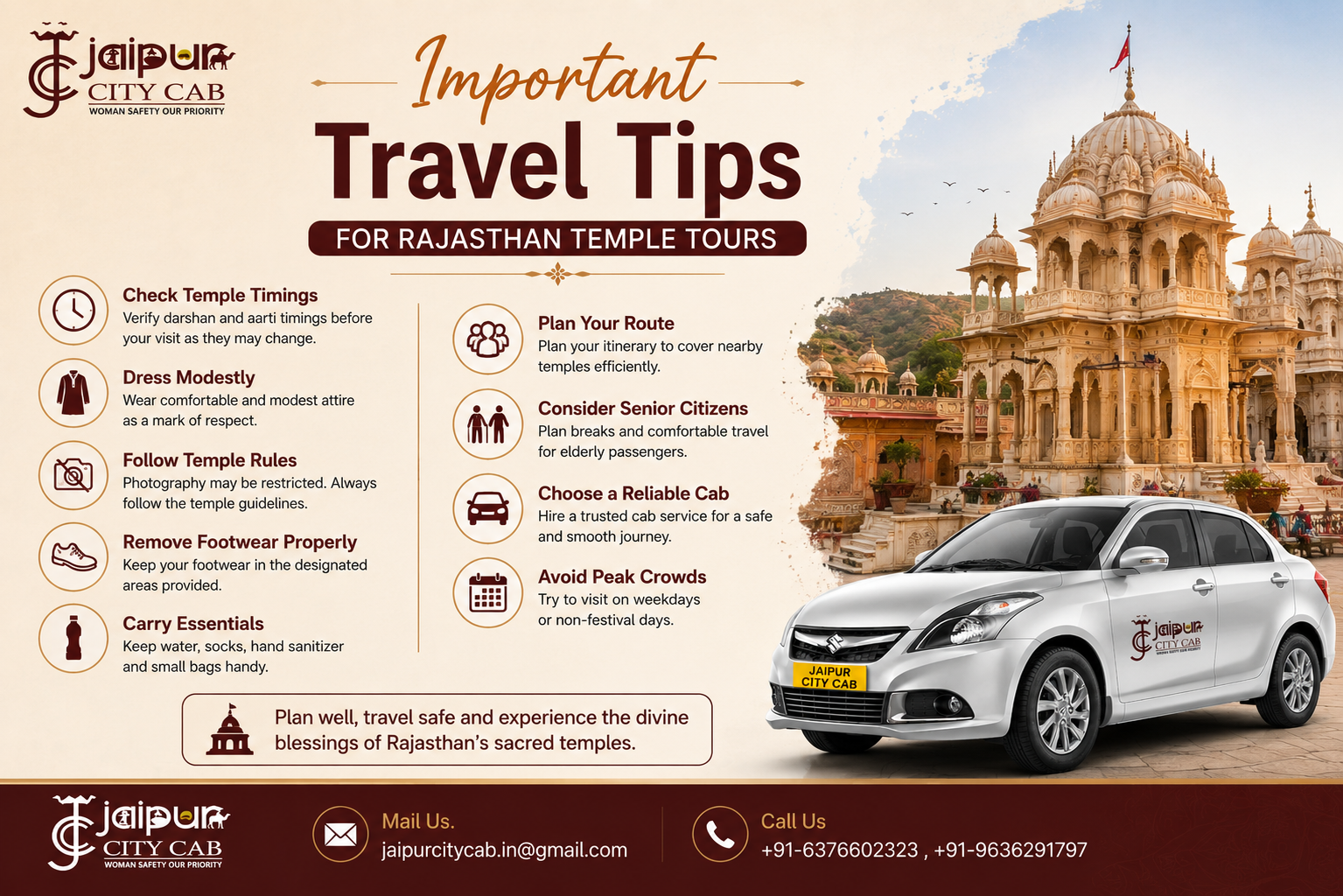
- Check the current temple schedule before leaving your hotel.
- Festival and mela days can completely change ordinary darshan timings.
- Start early for Khatu Shyam, Salasar and Mehandipur to avoid peak queues.
- Wear modest and comfortable clothing at religious sites.
- Carry socks during summer because temple floors can become very hot.
- Keep footwear only in designated areas.
- Photography may be restricted inside several temples.
- Avoid carrying unnecessary valuables or large bags.
- Keep drinking water in your cab during long Rajasthan road journeys.
- Senior citizens should avoid overloading one day with too many temples.
- Keep sufficient road-time buffer during Navratri, Janmashtami, Ekadashi and major fairs.
- Do not depend completely on old online temple timing information.
Why Choose a Private Cab for a Rajasthan Temple Tour?
A Rajasthan pilgrimage route is very different from a normal city sightseeing trip. Many temples open and close in multiple sessions, which means transportation must be coordinated around darshan timings.
A private cab allows travelers to leave early, stop for breakfast when convenient and adjust the route when darshan queues are longer than expected.
It is particularly practical for families traveling with children or senior citizens because the same vehicle remains available throughout the journey.
Jaipur can act as a convenient starting point for Khatu Shyam Ji, Salasar, Pushkar and Mehandipur. From there, travelers can continue towards Nathdwara, Udaipur and western Rajasthan.
For a customized pilgrimage journey, explore Jaipur taxi services.
Travelers arriving by flight can begin directly with a Jaipur Airport taxi and continue towards their selected pilgrimage route.
Frequently Asked Questions – Rajasthan Temple Travel Guide
Q1. Which are the most famous temples in Rajasthan?
Answer: Popular temples include Khatu Shyam Ji, Salasar Balaji, Govind Dev Ji, Brahma Temple Pushkar, Shrinathji Nathdwara, Eklingji, Ranakpur Jain Temple, Dilwara Jain Temples and Karni Mata Temple.
Q2. Can Khatu Shyam and Salasar be covered in one day from Jaipur?
Answer: Yes. An early Jaipur departure can cover Khatu Shyam Ji and Salasar Balaji in the same day, although festival days may require significantly more time.
Q3. What is the best time for a Rajasthan temple tour?
Answer: October to March generally offers the most comfortable weather for long road journeys and temple visits.
Q4. Do temple timings change in Rajasthan?
Answer: Yes. Several temples follow seasonal, festival or ritual-based timings, so same-day verification is recommended.
Q5. How many days are required for a Rajasthan temple tour?
Answer: A Jaipur-focused pilgrimage can be covered in two to three days, while a wider Rajasthan temple circuit generally needs around 8–11 days.
Q6. Can Nathdwara and Eklingji be visited together?
Answer: Yes. Both temples are located north of Udaipur and can conveniently be combined in the same road itinerary.
Q7. Is photography allowed inside Rajasthan temples?
Answer: Rules vary. Photography is restricted inside several temples, including some major pilgrimage sites, so always follow local instructions.
Q8. Can senior citizens do a Rajasthan temple tour?
Answer: Yes, but the itinerary should include fewer temples per day, suitable hotel stops and enough rest time.
Q9. Can I hire a private cab for a complete Rajasthan pilgrimage?
Answer: Yes. Private cabs, SUVs, Tempo Travellers and buses can be selected according to passenger count and route.
Q10. Which temple can be visited near Bikaner?
Answer: Karni Mata Temple at Deshnok is approximately 30–35 km from Bikaner and is one of the region's most famous pilgrimage sites.
Q11. Can Tanot Mata be covered from Jaisalmer in one day?
Answer: Yes. Tanot Mata and Longewala are commonly combined in a day excursion from Jaisalmer with an early start.
Q12. Should temple aarti timings be checked before travel?
Answer: Yes. Aarti and darshan schedules can change according to seasons, special seva, festivals and temple management arrangements.
Conclusion – Plan a Comfortable Rajasthan Temple Tour
Rajasthan's spiritual heritage is as varied as its royal history. Jaipur offers Govind Dev Ji, Moti Dungri and Galtaji, while nearby pilgrimage routes connect travelers to Khatu Shyam Ji, Salasar Balaji and Mehandipur Balaji.
Further west and south, the temple circuit expands towards Brahma Temple in Pushkar, Shrinathji at Nathdwara, Eklingji and Jagdish Temple in Udaipur, the magnificent Jain temples of Ranakpur and Dilwara, Karni Mata at Deshnok and the desert pilgrimage sites of Ramdevra and Tanot Mata.
The most important factor when planning this journey is timing. Several famous temples operate with separate darshan sessions, seasonal schedules or short aarti windows, so old timing information should never be treated as permanent.
For travelers beginning in Jaipur, a two- or three-day religious route can cover the Jaipur temples, Khatu Shyam Ji, Salasar and Mehandipur. A complete Rajasthan temple tour should ideally be planned across eight to eleven days depending on sightseeing interests and travel pace.
A private cab also makes the itinerary easier to customize around early morning darshan, lunch breaks, senior-citizen comfort and hotel locations.
For local and outstation pilgrimage travel, explore Jaipur City Cab taxi services.
For groups traveling together, you can choose bus rental in Jaipur or a suitable group vehicle.
For Jaipur temple sightseeing combined with major city attractions, visit our Jaipur sightseeing cab page.
For complete Rajasthan travel planning and customized transportation, visit Jaipur City Cab.


